New ACP Letter: Emerging low-cloud feedback and adjustment in global satellite observations
26 March 2026
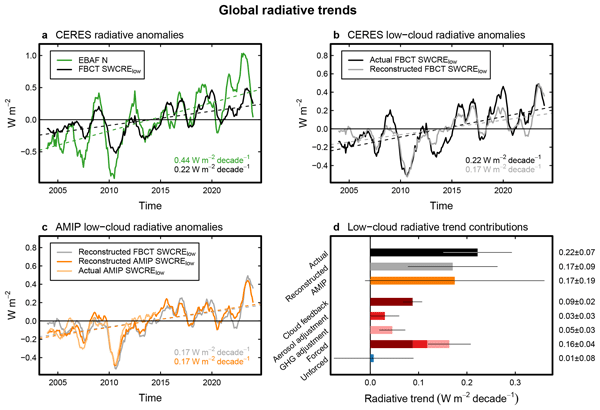
Recent decades have seen a marked decrease in global low-level cloud cover, leading to more sunlight heating the Earth. This trend is poorly understood, raising the concern that clouds may amplify global warming more than previously thought. The authors show that the cloud decrease is mostly caused by human forcing on climate, and that it agrees with previous estimates of how clouds respond to decreasing aerosol pollution, increasing greenhouse gas concentration, and their effects on global temperature.
Editorial statement: Recent observations show a decrease in global low-level cloudiness, which has implications for the rate of global warming. This study shows that the decrease can be explained by known physical processes – cloud feedback and adjustments to greenhouse gases and aerosols. Global climate models simulate similar trends, providing confidence that current estimates of aerosol forcing and climate sensitivity are consistent with the observational record.
Please also read the guest post on Carbon Brief.
Contact: Paulo Ceppi (p.ceppi@imperial.ac.uk)