New ACP Letter: Buffering of atmospheric nanoparticle growth by temperature-dependent shifts in molecular composition, volatility and diffusivity
24 August 2026
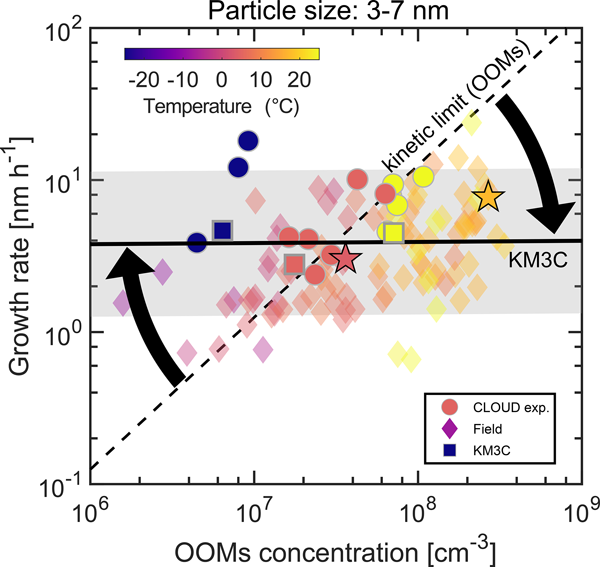
New particle formation in the atmosphere has long been a scientific conundrum because nanoparticle growth rates are less dependent on condensable vapor concentration than expected. The authors have developed a new multiphase chemical kinetics model that reconciles observational data from field measurements and chamber experiments. They uncover an effective buffering of particle growth rates through antagonistic effects concerning particle phase state and shifts in volatility distributions.
Editorial statement: New particle formation and growth have long been recognised as important processes in the atmosphere, with major influences on meteorology and climate, but a comprehensive understanding of the processes has proved elusive. This letter introduces a model considering the multiphase effects of temperature on the kinetics of growth through both condensation and diffusivity, and finds that these create opposing phenomena, moderating the growth rates and helping to reconcile atmospheric and laboratory data previously considered inconsistent. This approach may become key in better understanding and predicting particle growth in the atmosphere.
Contact: Thomas Berkemeier (t.berkemeier@mpic.de)