New ACP Letter: Correct use of radiative efficiencies in calculating global warming potentials and other emission metrics
10 November 2026
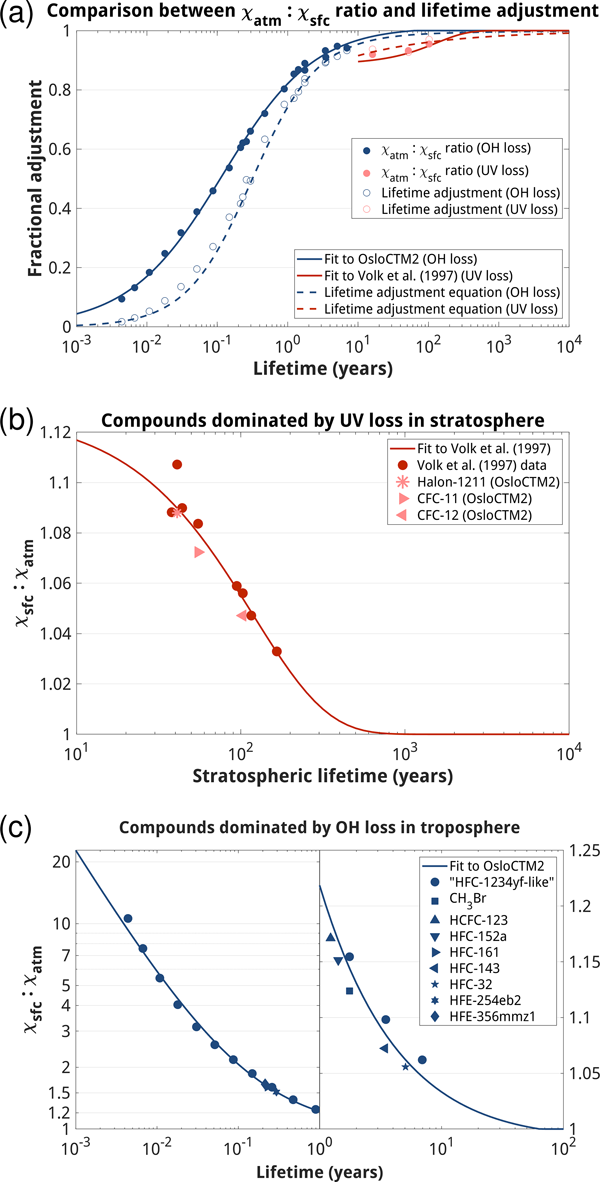
The global warming potential (GWP) is a commonly used metric for relating the climate impact of emissions of a gas relative to that for carbon dioxide. The authors show that previous calculations have systematically underestimated these values by applying calculations of radiative forcing efficiency appropriate to changes in surface mole fractions rather than changes in the mass-weighted mean mole fraction in the atmosphere.
Editorial statement: Global Warming Potentials (GWPs) convert a gas's radiative efficiency (RE) into a mass-based quantity (W m⁻² kg⁻¹) using the molecular weight and total atmospheric mass. REs are almost universally reported and used as radiative forcing per change in surface mole fraction, because that's what's measured and what radiative transfer models typically vary. For gases with non-uniform vertical profiles – those destroyed in the stratosphere (like CFCs, N₂O) or with short tropospheric lifetimes (many HFCs, HCFCs) – the surface mole fraction is higher than the atmosphere-wide mean, so plugging the surface-based RE directly into the mass-conversion formula systematically underestimates the actual mass-based radiative efficiency, and therefore underestimates the GWP. In this letter, the authors derive a correction factor (the ratio of the change in surface mole fraction to the change in mean atmospheric mole fraction) and provide empirical fits so this ratio can be estimated for any gas even without access to the original radiative transfer model output, leading to an upward revision of GWP values. The work has real potential consequences for regulatory thresholds and reported emissions-weighted climate impacts.
Contact: William J. Collins (w.collins@reading.ac.uk)